
|
Calcium my friend.docx Size : 14.029 Kb Type : docx |
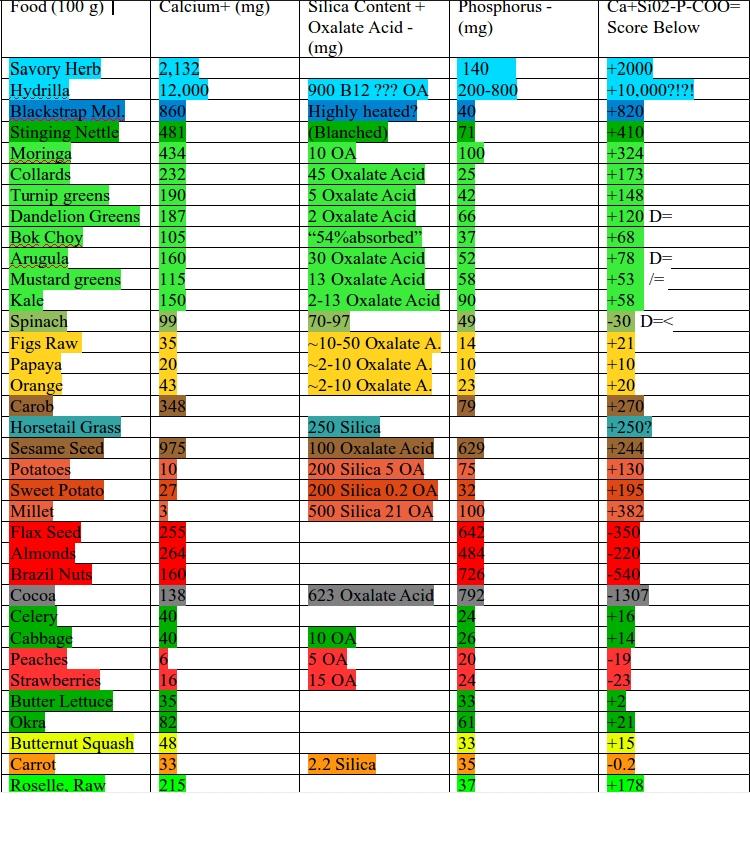
Silica
may be transmuted into calcium according to Dr. Louis Kervan, author
of Biological Transmutations.
8.5-10mg
of calcium/100ml of blood and 2.5-4.5mg of phosphorus/100ml of blood
is the ideal homeostasis levels, is this where the idea for more
calcium than phosphorus ratio originates?
I started this because
of trying to meet everything 100% in cronometer on a nearly
fruitarian, fully raw vegan diet and have done so with ease for the
most part besides calcium, so being low on calcium even when I
reduced the rda to 500mg as alternatively suggested as a acceptable
amount. Then I read into calcium more and learned that you should try
to keep your phosphorus and calcium ratios equal or calcium higher
which was never the case. With most fruit consumption usually
phosphorus is much higher than calcium heres an example.
30 bananas, 177 calcium and 778 phosphorus so I would need to catch
up to that with 2lbs of kale which doesn't even catch up so well. 2
lbs of kale gets me to 1537 calcium and 1613 phosphorus. 1lb of
collard has a nicer ratio compared which brings the calcium to 1230
and phosphorus 892.
I
don't want to be one sided so even though this was originally fueled
from cronometer calcium levels and then the ratios information which
I would like the believe is somewhat mutual and science based maybe
these statistics are still heavily influenced by outside sources
pushing calcium consumption through dairy sources.
“In the USA, the variety of dairy industries combine into a greater
than a $50 billion-a-year business, which raises and spends $206.5
million dollars annually to spread the myth that dairy foods are not
only a healthy choice, but are also essential to avoid becoming
sick.” people can adapt to have a normal calcium balance on calcium
intakes as
low as 150-200 mg/day
and that this adaptation is sufficient even in pregnancy and
lactation. Eskimo children get about 120mg daily and grow up with
healthy bone structures.
Too much phytate and too little
vitamin D seem to be a more typical cause of rickets and osteoporosis
which are the two main effects or claims of ill health effects
resulting from a lack of calcium. It seem that it's not that there is
too little calcium, but more so too many calcium absorption disabling
factors.
So basically I have come to no
conclusion
but would like to offer this as a informational collection of notes
leading others down a bit faster and safer path than the seemingly
ominous rabbit hole I fell into when trying to learn about calcium. I
think to figure out anything for certain I would need to conduct
various studies involving many years, but for now all I have is my
own body and what others have written and suggested as the truth. So
far I have been consuming more calcium rich greens like dandelion
greens and bok choy and recently nettle leaves. Now I give you what I
found to be factual, informational and beneficial towards considering
the processes involving calcium utilization and inhibitory factors in
the body, diet and lifestyle.
Professor T. Colin Campbell,
author of the famous China Study, concluded that “the association
between the intake of animal protein and fracture rates appears to be
as strong as the association between cigarette smoking and lung
cancer.”
Protein, sodium,
vitamins A, K and D, zinc, potassium, copper,
iodine, phosphorus and magnesium all affect the calcium
absorption process. Especially important to note is the
relationship between magnesium and calcium. These two elements rely
on each other greatly, both need to be present for proper absorption.
Usually in a 2:1 mg ratio, with two parts calcium to one part
magnesium. Vitamin D is another integral relation with calcium
assimilation and similar to magnesium phosphorus and calcium should
be held to a minimum of 1:1 or higher with calcium being higher.
A
compound is a chemical combination of more than one element, or
elements. Elemental calcium
is purely calcium, while calcium carbonate is an example of a
compound of calcium and other elements. Carbohydrates, proteins, and
fats are all examples of compounds, the body doesn't use elemental,
(metallic) calcium. The body uses calcium compounds like calcium
phosphate.
Elemental phosphorus is a white or yellow waxy
substance that burns on contact with air. It is highly toxic in it's
pure form.
Phosphorus
enters the plant
through root hairs, root tips, and the outermost layers
of root cells. Uptake is also facilitated by mycorrhizal fungi that grow in association with the roots of many crops. Once inside the plant root, P may be stored in the root or trans-ported to the upper portions of the plant. Through various chemical reac-tions, it is incorporated into organic compounds, including nucleic acids (DNA and RNA), phosphoproteins, phospholipids, sugar phosphates, enzymes, and energy-rich phosphate compounds. It is in these organic forms as well as the inorganic phosphate ion that P is moved throughout the plant, where it is available for further reactions.
Bones
are mostly made of calcium phosphate,
made up of the chemical elements calcium, phosphorus and oxygen, is
the form of calcium that dairy foods, such as milk and yogurt,
supply. Sardines, anchovies and salmon. Tooth enamel and bones are
very high in calcium phosphate, although supplemental forms have not
shown to be readily bioavailable. Dicalcium
phosphate and tricalcium phosphate are not so well absorbed because
the phosphorus binds tightly to the calcium.
Calcium
oxalate, where calcium ion
binds to an oxalate ion to form a solid crystal and is
difficult for the body to absorb. Foods that are high in calcium but
also high in oxalates do not contribute as much absorb-able calcium
as foods without oxalates. These high-oxalate foods include rhubarb,
spinach, collards, beet greens and Swiss chard.
Sea shells are
made of Calcium carbonate(most
common supplemental “salt”) creates stalagmites,
stalactites also limestone. Stalactites
are formed by a solution of calcium carbonate and other minerals
slowly dripping. Calcium carbonate dissolved in water is what makes
our drinking water “hard.”
Relatively
usable by the body, Aka common chalk, extremely
alkaline and found in Tums, other anti-acids and coral calcium. Can
help with acid indigestion and people but, stomach acid is important
for digestion and reducing it too much can interfere with digestion
and cause constipation.
Calcium sulfate includes the
chemical elements calcium, sulfur and oxygen. This form of calcium is
common in fortified foods, because it is stable. Calcium sulfate most
often comes from the mineral gypsum. One of the most widespread uses
of calcium sulfate in calcium fortification is as an additive to
tofu.
It's best to obtain the calcium from dietary sources
like greens to cover assimilation for various forms and this includes
supplements. Less than ideal calcium sources include calcium
carbonate, calcium citrate(supplement 'salt'),
calcium chelate, calcium gluconate, calcium lactate and
Microcrystalline hydroxyapatite crystals (MCHC) is crushed bone sold
as a supplement. More ideal forms of calcium are calcium phosphate,
calcium citrate malate, and calcium orotate.
If
you don't have enough calcium in your blood it is more difficult for
the body to absorb new calcium into the small intestine which is the
primary area of absorption. The
best forms of silica
come from cucumbers, celery, bell peppers, horsetail, nettles, oat
straw & alfalfa. Magnesium comes from many different sources
including nuts, seeds, legumes and green vegetables.
Tips to remember
for ensuring you absorb and retain calcium:
Avoid eating high fiber foods (like wheat bran cereal) together with calcium sources. One exception is the prebiotic fiber inulin, which appears to increase calcium uptake in the intestine.
Get plenty of sunshine or supplement your diet with adequate vitamin D (at least 600 IU for adults, I’d recommend 1000 IU)
Spread your calcium out throughout the day, whether from food or supplements. You’ll miss absorbing some of it if you take it in excess of 500 mg at once.
High sodium intake increases calcium excretion, so eliminate your salt intake.
Exercise will build bone density by requesting more calcium from weight bearing movement.
Maintain a alkaline body PH level with a proper diet so your body doesn't require calcium leeching to equalize blood acid-alkaline levels.
Stay calm. Stresso-genic hormones from elevated stress levels can increase calcium use for heart and other muscle contractions, increasing use, excretion and the need for more calcium intake.
Calcium combined with phosphorus makes up bone in the form of calcium phosphate.
Excess fats will bind with calcium to get eliminated, so it is important to have a low fat diet.
Calcium, Aluminum and magnesium bind to and remove phosphorus.
Calcium burns “brick” red!
Because Calcium can cause constipation, it is necessary to take roughly half that in magnesium at the same time you take Calcium.
How do you know if you are short on magnesium? You can get cramps in your calves at night and feel sore after some mild exercise or activity.
The usual suspects that cause calcium excretion are: caffeine, alcohol, cigarettes smoke, excess refined sugar, excess animal protein, and phosphoric acid.
Almost every green or veggie that is low in calcium has a higher phosphorus content than the ideal 2:1 ratio and the minimum is at least 1:1.
Diets low in calcium will increase oxalate stone risk, calf muscle cramps and depression.
The average adult body contains approximately 1 kg (2.2 pounds) of calcium.
Oxalate
Acids
Oxalate acids form in plants during the incomplete
oxidation of carbohydrates. Glycolate can convert to oxalate acid the
oxidation occurs in two steps with glyoxylic acid as an intermediate
and glycolic acid oxidase as the enzyme. Glyoxylic acid may be
derived from enzymatic cleavage of isocitric acid. Oxaloacetate also
can be split to form oxalate and acetate. Another significant
precursor of oxalate in plants is L-ascorbic acid.
In the
body, oxalic acid combines with minerals such as calcium and iron
forming crystals with the oxalates which are then excreted in the
urine as minute crystals. These oxalates can form larger kidney
stones that can obstruct the kidney tubules in some cases.
Berries
have generally high oxalate acid contents, low calorie fruits like
melons seem to have low oxalate acid contents and most fruits have
medium level oxalate acids, ranging in mg from 20 to 5.
The longer
a tea is infused the more oxalate acids will be extracted into the
water or tea. EG Indian tea per 100g.
2min 55 mg, 4 min 72 mg, 6
min 78 mg (seems to have a cutoff point) I'm guessing 8 min =
80mg?
Drinking water helps flush out High Oxalate acid
contents. The function of Oxalate's is to help plants dispose of
excess calcium. The human body has no use for oxalic acids at all.
Oxalate acids are waste product also formed in the human body.
Excessive amounts of Vitamin C more than 2,000mg/day convert to
oxalate acids.
PHYTATE Seeds, Grains, potatoes and
nuts!
Commercial food processing destroys phytase, which
means that the food retains more phytate. Other processes that
actually reduce total phytate are soaking, fermenting and sprouting.
When beans are sprouted, total phytate goes down by as much as 75
percent. Phytate is found in all plants because it stores the
phosphorus needed to support germination and growth. An enzyme called
phytase neutralizes the phytate to release the phosphorus. Plants and
most animals have their own phytase. Unfortunately, humans don't.
Bacteria in the intestine produce small amounts, but not enough to
digest phytate. The phytate then binds with iron, calcium and zinc,
which means the minerals can not be properly absorbed.
Phytate
is highest in bran-based products, wheat bran, rice bran, whole
wheat, corn, rye, oats and brown rice at the top of the list. Soy,
pinto, kidney and navy beans, as well as peanuts, are at the high
end. Nuts do contain phytate, but the amount ranges from
approximately .4 percent to as high as 2 to 3 percent. Cooked
potatoes may account for a substantial portion of the average
American’s daily intake of phytate.
Phytate binds with
minerals and prevents their absorption, possibly leading to
deficiencies, especially if your diet is high in fiber and
whole-grain foods.
Hydrilla
Verticillata sources..
http://duffitness.com/hydrilla-verticillata
http://www.apms.org/japm/vol21/v21p87.pdf
The
sources in general if you desire to find them copy and paste a small
selection into google since much of this is copied and pasted.
Otherwise I request a massage to find them again myself, everything
here is relatively reliable if you think something is wrong I'd
appreciate you telling me what and why!
